WriterZen - Keyword Search Volume: Everything You Need to Know

Keyword search volume is a vital metric in search engine optimization.
Whether you are working to develop an organic content marketing strategy, create a new website, or devise a pay-per-click marketing strategy, you must consider keyword search volume.
Keyword search volume estimates how many times a keyword gets searched online during a defined timeframe.
The number gives you an idea of the popularity of specific keywords throughout the year or during a season and their potential to drive traffic toward your site.
Considering that more than half of all traffic to websites comes from organic searches, it is good to develop a strategy to capitalize on it.
However, inexperienced marketers too often take the search volume numbers at face value and make poor decisions.
This article will discuss all there is to know about keyword search volumes and how to find the right keywords to target for your content marketing strategy.
How Keywords Work
Keywords are phrases that search engines recognize based on the words that searchers type. They help the search engine bots that crawl the pages to understand the web page.
Using the keywords, the bots accurately index the pages in the search engine's database.
The next time a user searches for something online, the search engine includes all the pages with relevant keywords in the search engine results pages (SERPs).
It can be seen from this that having relevant keywords is an essential component of SEO.
However, it is also important to remember that throwing a few keywords into the page or stuffing it would result in your page being penalized. What is needed is high-quality content that incorporates the keywords organically into the page.
What Is Keyword Search Volume?
So what is keyword search volume precisely? The keyword search volume estimates the number of times a keyword gets searched during a specific period on the search engine.
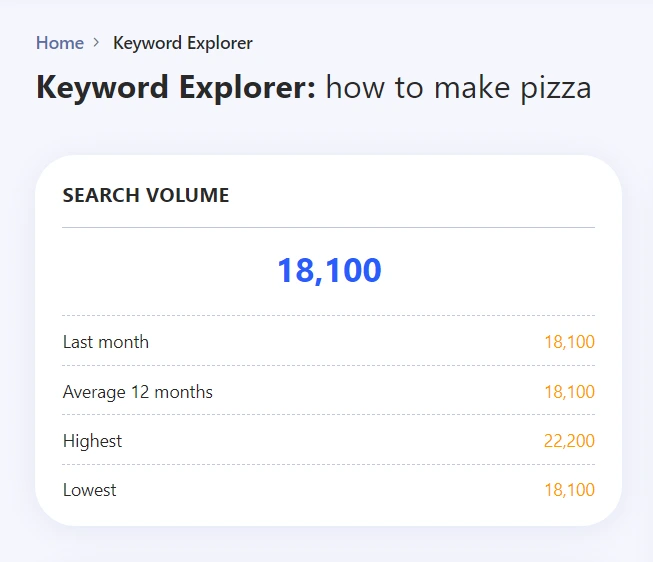
It is an important metric used by SEO marketers to understand how certain popular words are during a given season or how competitive the keywords are.
Knowing the search volume plays a big role in defining their strategy as marketers can generate content with keywords that are most likely to drive traffic to their site.
For example, marketers might look at the monthly average number of keywords such as “Christmas presents” or “Cheap Halloween Costumes” to understand when to leverage the keyword popularity.
Long-term strategies involve observing keyword trends over a year or more to understand its volume over extended periods.
Whether searching for products and services or relevant information on a topic, the search engine is where most of the journey begins.
Queries often take searchers to different domains depending on how well the sites have planned their search engine marketing strategy based on the keyword search volume.
What Constitutes Good Keyword Volume?
A good keyword search volume is in the minimum range of 100 to 1000 searches in a month. It would be counterproductive to dump all keywords you can find with a search volume in the thousands.
You need to be careful about competition for high-volume keywords.
Thus, there is no fixed rule for choosing the ideal keyword volume. It depends on the following factors:
The type of industry you are in as the keyword search volume would depend on it.
Pick keywords with low-enough competitive rates but high-enough volume.
Avoiding rarely searched words. Using rarely searched keywords would mean most people won’t find your content.
Avoid keywords with extremely high search volumes. It would put you in competition with the biggest sites.
You only spend more on competitive keywords if you are at the helm of a corporate site with a huge budget.
Thus, your content strategy has to incorporate both low and medium-volume keywords.
Staying in this range allows you to compete for the ranks using moderately competitive keywords while using a better-focused topic with low-volume niche keywords with low competition.
For example, you can go for low-volume keywords in the range of 100-1000 and medium volume keywords in 10,000 to 100,000 searches.
Evergreen and Seasonal Keywords
Keyword search volume can also depend on the topic searched and the time of the year.
Evergreen keywords have a high search volume throughout the month, regardless of the season. Searches such as “best restaurants near me” or “how to change a flat tire” would remain high throughout the year.
Seasonal keywords tend to peak during an event or particular season. “Christmas present for boy” or “Valentine’s day gifts” are seasonal keywords that begin to pick up the volume in the weeks leading up to the day.
Low-Volume Keywords
Are the keywords still relevant if you’re stuck with low-volume keywords or in a niche industry dominated by keywords?
Definitely yes! However, are the keywords still relevant? Nothing is concrete as hundreds, if not thousands, compete for your competitive edge.
It is important to understand that every available keyword can be used to generate traffic and not just the high-volume ones.
Low-volume keywords can become important team members in content strategies in the hands of experienced content marketers. Here is how low-volume keywords are relevant:
Topic Clustering and Low-Volume Keywords
Topic clusters or “content hubs” are excellent places to use all the keywords available in your arsenal in your content strategy. Topic clusters get made of a “pillar” or a “hub” topic linked to “spokes” or “satellite” topics.

The pillar topics are targeted at the higher volume keywords, while the satellite pages contain specific content related to subtopics targeted at low-volume keywords.
This content approach can drive significant traffic when executed strategically as the search engines recognize your site as an authority on the pillar topic.
Any such good quality content that establishes you as an authority figure on the subject is favored by the search engines as your site will be able to satisfy most of the user’s needs- such as the detailed information they need on specific topics.
Low-volume keywords around pillar topics are also excellent sources of content ideas to build on the main subject. These keywords are often long-tail keywords with a high ‘intent’ toward the topic a user is searching for.
So, while pages optimized for long-tail content may not bring in traffic individually, they work in a cluster with the pillar topic to drive traffic that would otherwise have missed the page.
These keywords would also increase conversions as they draw specific users with intent.
Niche Industries and Low-Volume Keywords
Low-volume keywords find their highest relevance in niche industries or topics that usually don’t have much traffic.
The general impression about SEO relates mostly to highly popular sectors such as e-commerce, entertainment, and education. More businesses don’t fall under the spotlight and thrive on the low-volume but highly targeted traffic.
Popular keyword tools such as Google Keyword Planner or Google Trends generally underreport or exclude many of these low-volume keywords.
SEO marketers in such niche industries will have to rely on more specialized and sophisticated keyword tools to acquire data and search volumes.
A thorough competitive research based on established sites in the niche also becomes an avenue to dig out hard-to-find keywords.
Finding Keywords and Keyword Volume
Like everything else with SEO, there are tools to help you find keywords relevant to your topic and their search volumes.
There are two different ways to do it; first, using the search engine data, they report themselves or clickstream data using the search engine data.
Google Ads Keyword Planner
Google reports Keywords and search volumes in its Keyword Planner tool. Since the company has a 92% search engine market, it is a go-to tool for how to find keyword search volume.

This resource gives highly useful insights regarding keyword volumes but has some drawbacks:
The tool is highly specific to Google Ads-related keywords; therefore, not all keywords get reported.
Access to Keywords Planner is limited to those who have a Google Ads account.
The volume numbers in the Keywords Planner can be inaccurate as estimates are made considering similar keywords and are often aggregated.
Keyword Planner is not useful for upcoming or newer keywords as the tool has a time lag.
Google hides keywords it deems as sensitive in certain areas, even when the words have ad potential.
It’s also important to know that the volume numbers get rounded off, with the reports being the average search volume. Keyword Planner takes 12 months; therefore, the reported figure is not specific to the month but the year's average.
Google Trends
Google trends is a highly useful tool that draws data from searches by users across a region or topic and compares frequencies with related or similar keywords across different domains such as geographical boundaries and language.

Keyword search volume is a vital metric in search engine optimization
https://writerzen.net/blog/keyword-search-volume
#WriterZen, #keywordsearchvolume, #keywordsearchvolumeWriterZen


Nhận xét
Đăng nhận xét